








CHICAGO (WGN) — A federal judge has ordered Border Patrol Chief Greg Bovino and recently departed ICE Chicago head Russell Hott to sit for depositions, as the court examines whether agents violated a temporary restraining order during recent operations in the Chicago area.
Kyle Harvick, a Customs and Border Patrol Incident Commander who’s been with the agency for 25 years, is in court in full uniform at the Dirksen Federal Building on Monday. Shawn Byers, a U.S. Immigration and Customs Enforcement (ICE) Deputy Director, is also in court.
Judge Sara Ellis is asking Harvick and Byers about the use of force by federal immigration agents and indicated she’ll specifically inquire about several incidents that have occurred during Operation Midway Blitz.
Ellis last week ordered a top ICE official, Hott, to appear in court Monday to explain the actions of immigration enforcement agents, particularly to tell her why she was still seeing tear gas deployed on protesters and reading reports of no advance warnings given after she had issued an order against such methods.
Ellis said she’s “profoundly concerned” officers are not following her order.
It was unclear up until early Monday morning which federal official or officials would be in court after Hott abruptly left his post in Chicago to return to his previous role on the East Coast.
In a statement to WGN, a Department of Homeland Security (DHS) spokesperson said:
“Russell Hott is the permanent Field Office Director for the Washington, D.C., area of responsibility, not Chicago. He served in Chicago as interim FOD, and this is a planned return to his permanent office in D.C.”
According to the statement, Samuel Olson, normally stationed at the ICE field office in Minnesota, will now serve as interim leader in Chicago. But he did not appear in court Monday, either.
Court documents show the Department of Justice offered instead to make Harvick and Byers available to Ellis. The documents also state that DHS believes Border Patrol is primarily involved in the incidents at issue, not ICE.
However, during Monday’s hearing, Ellis ordered Hott and Border Patrol Chief Greg Bovino to sit for depositions.
Ellis says they will not be asked about the Trump administration’s policies or goals of “Operation Midway Blitz,” only about what’s happening on the ground in Chicago, whether people exercising their rights to protest or express views are being specifically targeted for their views and whether use of force is appropriate.
“I don’t think it matters what the administration’s objective is. This lawsuit is about how our ICE and CBP officers are enforcing the laws,” Ellis said. “It is not all relevant whether the administration is seeking to enforce the immigration laws in Chicago verses Austin, Texas.”
The action from the courts was prompted by recent clashes between protesters and federal agents, which have become increasingly common in Chicagoland.
Ellis previously banned federal agents from using certain riot control techniques against peaceful protesters and journalists. However, she expressed concern last week about possible violations of that order during a series of incidents Tuesday on Chicago’s Southeast Side.
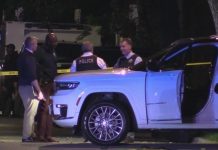
Agents used a PIT maneuver to stop a vehicle in a residential neighborhood and arrested two people in the SUV, who they say are undocumented Venezuelans and allegedly rammed the agents’ vehicle first. The stop sparked a tense standoff.
WGN-TV cameras captured what appears to be an egg thrown at agents, who responded by deploying tear gas into the crowd. A DHS official claimed protesters were throwing rocks.
In response, Judge Ellis modified her temporary restraining order, requiring all agents involved in Operation Midway Blitz to wear body cameras and ensure they are turned on. A Justice Department lawyer, however, said not all agents are equipped with body cameras.
Officials respond
In court Monday, Ellis asked Harvick how Border Patrol agents’ responsibilities compare with ICE agents’ resonsibilities.
“We were tasked by the Secretary (DHS Secretary Kristi Noem) to come to this area to see if there’s any illegal immigration happening, persons here illegally, and conduct enforcement under Title 8,” Harvick replied.
Ellis also asked if her temporary restraining order governing conduct toward peaceful protesters and its subsequent modifications, including the requirement to wear body cameras, have been communicated to Border Patrol officers.
“Yes, ma’am,” Harvick replied. “For Operation Midway Blitz, we are assigning every Border Patrol agent a body-worn camera. … Every agent now has a body-worn camera.”
Harvick said Border Patrol has 201 officers and command staff operating in the Chicago area right now, with a peak of 232 officers a week or two ago.
Ellis also inquired about the use of tear gas in Albany Park on Oct. 12. Harvick said it was an enforcement action after witnesses joined arms.
“The situation gets more and more dangerous the longer we are there,” he said. “That’s a safety concern not just for my agents, but also for the detainee and public.”
According to Harvick, in that incident a dispersal order was given before tear gas was deployed.
“Whose decision is it to use non-lethal force?” Ellis asked.
“It can be any agent … based on objective reasonableness coming from the totality of the circumstances,” Harvick responded.
Ellis then turned to the incident last week on the Southeast Side that led to a standoff with the community.
Harvick said he didn’t review body-cam footage or reports about the incident and only spoke to a supervisor who had arrived at the scene toward the end of the incident.
“Some of those individuals started throwing objects,” Harvick said. “I heard eggs, bricks and metal objects, and an officer was struck in the head by an egg. The longer you’re on the scene, the more people come.”
This is a developing story and will be updated.