



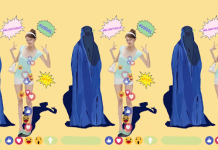




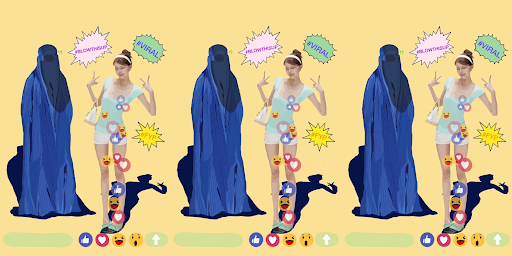
There’s a trend online where a woman will post a picture of herself, and next to her is a woman in a burka, with text in the middle: “across the world, there is a woman just like me, with the same abilities and the same desires, same work ethic and love for her family, who would most likely make better films and better speeches. Only she sits in a refugee camp and she has no voice.” The quote comes from a speech actress Angelina Jolie made while receiving The Jean Hersholt Humanitarian Award at the 2013 Governors Awards, an award she won for her extensive humanitarian efforts, such as being a Special Envoy for the United Nations High Commissioner for Refugees and the co-founder of the Prevent Sexual Violence Initiative. In the trend, women compare their situations to those of women in Afghanistan, with text like “ I wish I didn’t have to go to school” on one side, and a response on the other seemingly from the Afghan woman’s perspective, something along the lines of “you are allowed to go to school?”
This trend seems well-intentioned; it’s meant to spread awareness. Yet the photos these creators use are of them in their happiest moments: at graduation, or after getting a job. Their photos are a striking difference from the one on the other side of the woman in the burka, forcing a shock factor that almost creates a caricature of the situation many Afghan women are in. The text in these videos speaks for Afghan women, and though it may seem to be a reasonable assumption of what these women may be thinking, these assumptions take away any input Afghan women could have had on the trend. Instead of quoting actual Afghan women, participants of this trend choose to use the words of Angelina Jolie, whose words vaguely fit the issue at hand but does not have any real connection to the ongoing issue in Afghanistan. A white woman’s words, this trend exemplifies, will always receive priority and importance even when there are better options. Those who take part in this trend decide both the words being said and the photos being used in the video to portray a version of Afghan women tragic enough to stir viewers to like and comment, but enough to do proper research.
The oppression that Afghan women face does not start or end with the burka. One of the biggest issues that Afghan women face today is that many of them cannot manage to support themselves. The Taliban has issued bans that stop women from working for international and national NGOs and civil services. This isn’t to say that Afghan women are completely helpless. When I spoke to the founder of the Kalaam Project–a Chicago based non-profit created to support and uplift the stories of Afghans, Sayeda Qader, she told me that Afghan women sew clothing, own tailoring businesses, and run bakeries. These jobs are mostly domestic, and sometimes informal, but the fact that Afghan women can support themselves to some extent is something Western media does not report on. This selective reporting causes the transformation of Afghan women from humans to perfect victims.
The trend of placing oneself next to a woman in a burka focuses more on the creators themselves than the people they are meant to help. What this trend truly highlights is not the women in Afghanistan, but how influencers have turned Afghan women into props without understanding the full extent of what oppression they face. This lack of understanding can be linked to orientalism, an idea introduced by Palestinian academic and activist Edward Said, that, at its core, explained the Western view on the East: exotic, inferior, and fundamentally different. Orientalism is almost a perfect explanation for why this trend came to rise in the first place. Orientalism allows these influencers to turn Afghan women into objects in their videos to place themselves against and express how grateful they are for not being in the other’s place for millions to like and see and agree with. When these creators click post, do they think themselves self-aware for turning one woman’s oppression into the backdrop for their gratitude? Do they see the actual women behind the burka or do they stop at just the fabric?
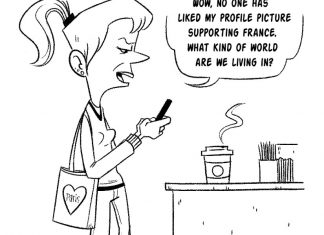
When I asked Sayeda Qader on her thoughts on the trend, she told me how she thinks “any awareness is good, however, the downfall of so much awareness is that it is done without any actionable steps when there is so much that can be done.” The thing about trends, though, is that they create echo chambers, which leads to the same (mis)information being regurgitated again and again, which in Sayeda’s words, “[doesn’t] really contribute to the cause”. If we truly want to improve life for Afghan women, liking and sharing tasteless trends on social media is not enough. There are countless things that can be done, none of them particularly difficult. The simplest way to help women in Afghanistan is to donate to organizations like the Kalaam Project, which directly helps women by getting them things like sewing machines so they can support themselves.
Donating is one of the more obvious things to do, however, there are Afghans in the United States who would benefit from help as well. In 2021, the Biden administration launched Operation Allies Welcome (OAW), which led to the evacuation of 76,000 Afghans, who were granted humanitarian parole. The unique thing about humanitarian parole is that it does not grant citizenship or green card status, unlike refugee and asylum status. In March of 2022, these individuals were eligible to apply for Temporary Protected Status, which allowed them to stay and work temporarily in the U.S. for eighteen months without the threat of deportation. In July of 2026, the Trump administration terminated the Temporary Protected Status Afghans had. This led to a limbo for Afghans who were in the process of getting other legal status, like asylum or refugee status. This means that Afghans who have pending cases are at risk of being deported before their cases are processed. Though this was not the exact story for Mohammad Nazeer Paktiawal, his was similar. On March 13, Paktiawal was detained by ICE, and around a day later, his family received the call that he was dead. ICE said that Paktiawal’s humanitarian parole had expired in August of 2025. Paktiwal was not just an Afghan evacuated to the U.S., he was a war time ally who participated in many high-risk operations during the Afghanistan War. Paktiawal’s brother shared that his brother had a pending immigration case. Mohammad Nazeer Paktiawal’s story is just one of many Afghans in the United States right now.
Participating in online trends does not equate activism, especially when actually benefiting Afghans in the United States is as simple as calling your representative and asking them to give some protection to Afghans who have immigration cases pending would be enough to help give them a voice and improve their circumstances. To truly create change for the Afghan people, society has to look past social media trends that boil down the issue, and take definitive action.